.png?width=298&height=78&name=sierra-logo%20(1).png)
![SIERRA-Logo [Navy]](https://www.sierraventures.com/hubfs/SIERRA-Logo%20%5BNavy%5D.svg)


 Back
Back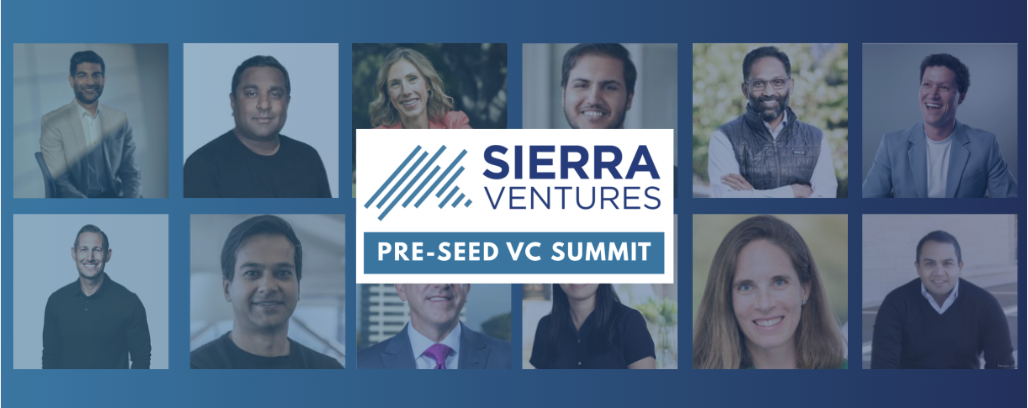
Written by
Anne Gherini
Published on
March 26, 2026
Share


SIERRA Ventures Pre-Seed VC Summit: $90B in AUM in one room
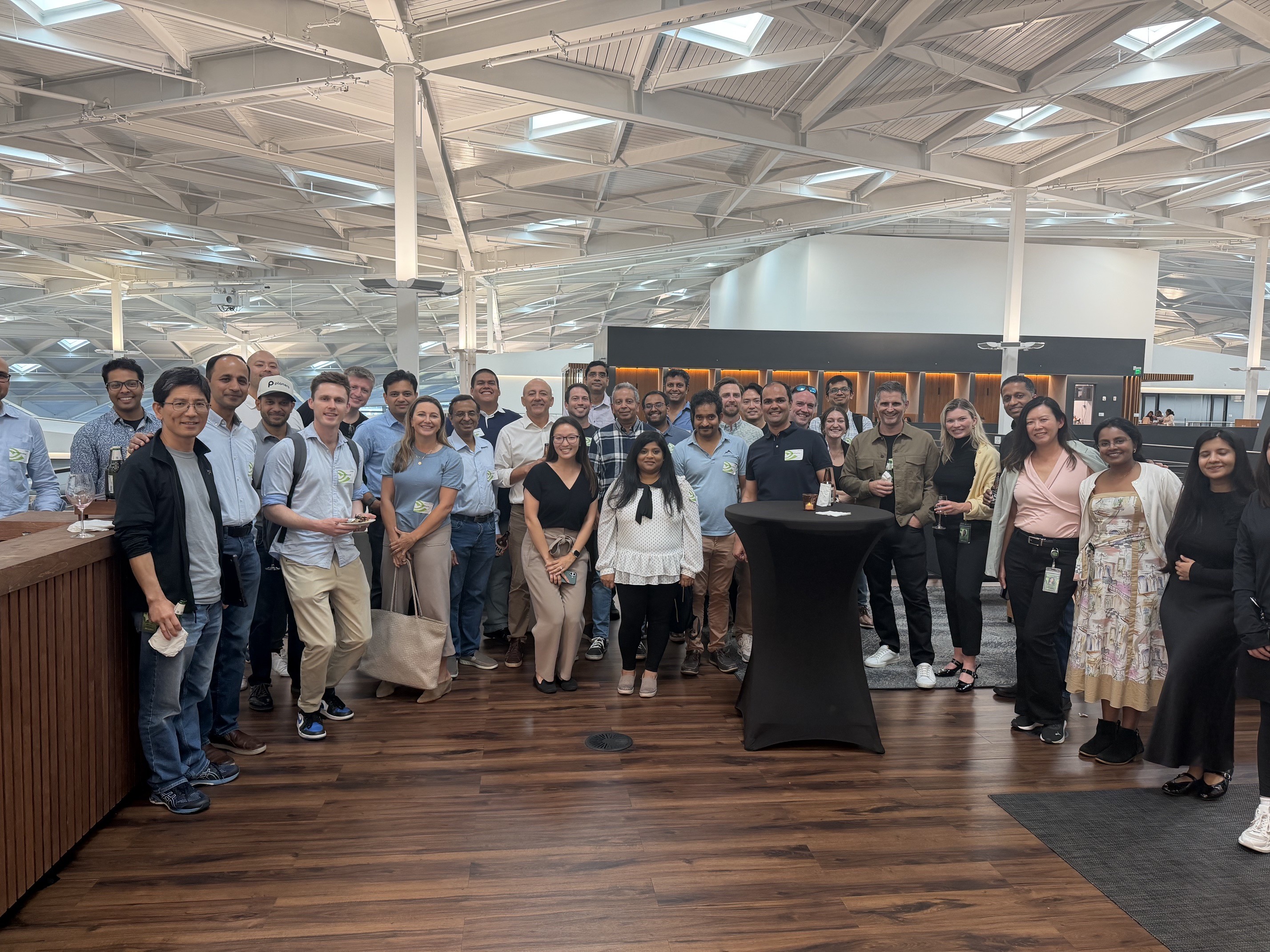
100+ first-check GPs and LPs gathered at the SIERRA Ventures Pre-Seed VC Summit for a day of candid conversation about what it actually takes to build and fund companies right now.
Collectively, they represented more than $1B in first-check AUM, over $20B in follow-on capital, and more than $70B in LP AUM, shaping how the next generation of companies gets built and financed.
Semil Shah of Haystack Ventures set the tone with a fireside chat that challenged how founders and investors should think about the AI era. Peter Walker, Head of Insights at Carta, brought the data. Sandesh Patnam of Premji Invest offered the growth and public market reality check. Ethan Batraski of Venrock, Lisa Xu of Threshold Ventures, Shravan Narayen of IVP, Elizabeth Weil, and Anamitra Banerji debated what actually gets funded across the seed-to-Series-B spectrum. And LPs Margo Doyle of S-Cubed Capital, Aakar Vacchani of Fairview, Apurva Mehta of Summit Peak, and JD Montgomery of Canterbury Consulting delivered the kind of candor about the LP market that most GPs only hear behind closed doors.
One theme ran through nearly every session: get comfortable with the unknown. Nobody knows where we are in this cycle, how drastically AI will reshape the workforce, or how differently we will build and invest five years from now. But uncertainty has never been a reason to stop building. If anything, it is the condition under which the most important companies get started.
The 100x Founder Just Became 1000x
Semil Shah opened with the provocation that set the tone for the day: the best founders have always been outliers, but today's tools have widened the gap between exceptional and average more than ever. A 100x person with access to modern AI is now a 1000x person. Taste and execution velocity have become the primary differentiators. In a world where anyone can spin up a product in a weekend, the question is no longer whether you can build. It is about whether you can build the right thing faster than everyone else.
The data backs this up in a striking way. Headcount across more than 50,000 venture-backed companies has been essentially flat for two and a half years while funding has continued to rise. Those two metrics have historically moved in lockstep. Median team size at seed has dropped from 10 to 6. At Series A, from 25 to 17. These are not just efficiency gains. They are a signal that the architecture of how companies get built has fundamentally changed.
For Shah, this reshapes early-stage evaluation entirely. The question is not whether a founder has the right resume. It is whether, after a few hours of real conversation, you feel like they are walking circles around you, seeing around corners you cannot see. If the answer is yes, that is the bet. The tools change. That quality does not.
The Bar Has Moved — And Nobody Agrees Where It Landed
The most honest admission from the room: nobody has fully recalibrated yet.
Growth-stage benchmarks that felt ambitious three years ago look modest today. Companies now coming in for Series B and C funding are growing 6x, 7x, even 10x. The middle of the distribution has been compressed. Either you are growing at a rate that would have seemed unreasonable in 2021, or you are making the case that you are building something so foundational that revenue is beside the point entirely.
For founders operating somewhere in between, growth investors have narrowed their aperture to the extremes. The $100M pre-seed rounds with zero revenue are happening. So are the $100M Series Bs with explosive ARR curves. Everything in the middle is harder to finance. The rounds themselves have also lost their traditional shape — Series As that used to be $10-15M are now $25-30M, and seeds are coming in anywhere from $7M to $50M. The labels have become almost meaningless. What matters is a clear-eyed view of what you are building toward and what the investor across the table needs to believe to get there.
You Are Either Building Infrastructure or You Are Cycling Tokens
Think back to Facebook's ads business in 2016 and 2017. The direct-response product drove $15 billion in incremental revenue, almost entirely funded by venture-backed D2C companies routing spend through the platform. One company captured the value. Most of the others were funding its growth. As Ethan Batraski of Venrock laid out, the same dynamic is playing out right now — OpenAI and Anthropic are Facebook, and the thin-wrapper SaaS companies building workflow tools on top of their APIs are the D2C brands.
The companies that survive are the ones that built something the model cannot absorb: access to private data the frontier models do not have, system integrations so deep inside the customer's stack that even a better alternative cannot get ripped out, or a presence in the physical world where model capabilities do not reach. If your moat is not one of those three things, you are generating tokens, not building a business.
Sandesh Patnam framed the same risk from the investor side. The frontier model companies are not staying in their lane. Just as Amazon co-opted open source and moved up the stack, OpenAI and Anthropic will do the same. The companies with staying power are the ones building where the models are not going.
What "De-Risked" Actually Means to a Growth Investor
The differentiation question — why can't OpenAI just build this — is one of the laziest questions in venture and also one of the most common. The better frame is not about differentiation at all. It is about de-risking.
What growth investors are actually evaluating is what has changed since the last round. What was uncertain, and what has been proven? Has the market opened up or closed down? The narrative that lands is not a defense of why you are different. It is a clear account of what you said you would prove and what you actually proved. Founders who lead with that arc are having a fundamentally different conversation than those defending differentiation from a standing start.
Valuation Is a Double-Edged Sword
The instinct to maximize headline valuation at every round is one of the most reliable ways to damage a company's future. A familiar pattern from 2021 is re-emerging: companies raising so far ahead of their operational reality that they paint themselves into a corner. The valuation feels like validation until the next round arrives, the comps have shifted, and a company with genuine fundamentals is suddenly facing a flat or down round.
At the seed stage, velocity is the only real moat and capital compounds velocity. Take the money if you have the demand. But as you move later, the right mental model is to work backwards from what a public market investor would pay for a business at your scale in an exit environment that looks like today's. For Series A founders, the practical guidance was consistent: anchor around what you actually need, and let demand pull you up. Average post-money for Series As right now is $100M to $200M with most companies having some revenue. That is the baseline, not the ceiling.
One idea gaining traction in growth-stage portfolio management is structured tenders as an alternative to repeated primary raises. [CONFIRM SPEAKER] Systematically offering employee liquidity keeps the cap table cleaner, gives early investors a path out, and leaves the company better positioned if an acquisition conversation opens up.
TAM Is Dead. Long Live the Labor Budget.
Nobody at the growth stage believes the bottoms-up TAM calculation. Nobody at Seed is going to hold a founder to it. But market sizing still matters. The frame has just changed.
The more compelling argument is the labor budget. The total spend on human beings doing the work a product automates is a payroll line item, typically 10x to 100x the size of the software budget alongside it. When AI collapses the employment pyramid, that spend migrates toward the tools. Every TAM in every industry just got reframed.
The credible version of this story is not a number on a slide. It is a specific customer, a specific value delivered, specific incumbents being displaced, and a clear vector for how that foothold expands. The number follows from the story. Founders who lead with the story and let investors do their own math tend to land better than those defending a market size calculation everyone is going to throw out anyway.
The Circular Economy Problem Nobody Wants to Talk About
One uncomfortable thread running through the day: founders raise venture capital and use it to buy compute from OpenAI and Anthropic, who are themselves venture-backed, whose usage revenue flows back into the ecosystem as further investment and model development. How much of the AI SaaS revenue in the market today reflects genuine enterprise value creation versus a self-reinforcing loop?
The discipline is going back to first principles on every investment. For founders, the honest version of the question is worth sitting with: if your top ten customers were not themselves venture-backed AI companies, would they still be paying you?
The Founders Who Win Look the Same as They Always Did
The classic markers still hold across every conversation. Domain gravity, the ability to recruit exceptional people, and a founder who is also the company's best salesperson in the first five years. What has shifted is that domain expertise as a strict prerequisite has loosened. The AI-native founder who moves fast is sometimes outpacing the domain expert who moves more deliberately, and the customer mindset has opened up in ways that would not have happened five years ago.
The most evocative test making the rounds among investors: is there a cult around this founder? Not in the pejorative sense, but in the sense that people who know them trust them enough to follow without a fully formed product. It does not show up in a metrics deck, and it tends to be the leading indicator for the companies that look obvious in hindsight.
What LPs Are Actually Looking For Right Now
For founders who want to understand how the capital for their next round actually flows, the LP sessions offered a useful window.
The structural reality is challenging. There are more than 5,000 active VC firms in the US, over 33,000 check writers globally, and commitments to venture funds have outpaced distributions by $200 billion since 2022. LPs are more selective as a result, and the GP who breaks through is the one who can answer one question faster than any other: why will a founder choose your capital over the 4,999 other options?
The evaluation framework that resonated across the LP conversations came down to three things: a pattern of success, a clear and genuine why, and demonstrated taste in the founders you back. The third one is where most GPs reveal themselves. A strong network and a timely thesis are table stakes. The GPs breaking through right now have a right-to-win that shows up in founder references before it shows up in a deck.
The Fog Is the Feature, Not a Bug
Nobody in the room had a clean map of where this ends. Which models win, which categories survive the next revision, which companies are building real businesses versus riding the wave — the honest answer across every session was some version of we will know more in a few years.
It is not unlike the fog that rolls into San Francisco most mornings, swallowing the Golden Gate and erasing the skyline. You cannot see what is ahead. But you do not stop driving. Right now, this city is in the middle of one of the most concentrated booms in its history, with cranes, capital, and talent converging at a pace the world was not quite prepared to see. The fog did not stop that either.
Semil Shah's advice was simple and stuck with the room: control your inputs, not your outputs. Who you spend time with, where you focus your energy, how prepared you are when the moment arrives, and where you place your conviction. You cannot see through the fog. But you can keep moving deliberately through it, and for those who do, it has always been the feature.
Watch the Highlight Video
Written By