.png?width=298&height=78&name=sierra-logo%20(1).png)
![SIERRA-Logo [Navy]](https://www.sierraventures.com/hubfs/SIERRA-Logo%20%5BNavy%5D.svg)



Written by
Anne Gherini
Published on
March 21, 2026
Share


Summary

The bar has moved — Anthropic hit $1B revenue in 2 years, Cursor in 3. What used to be "great" traction is now table stakes. Benchmark accordingly.
Protect your equity structure early — 25%+ of two-founder teams lose a co-founder by year four. If you don't have vesting schedules, that can kill the company. Also skip the 20% option pool — the actual median at seed is 12%.
Getting to Series A is hard — Only 14-17% of seed companies reach Series A at the 24-month mark, down from ~30% during the boom. Plan your runway assuming it takes closer to 2 years, and that you may need a bridge.
Share


Inception Investing in 2026 According to Data
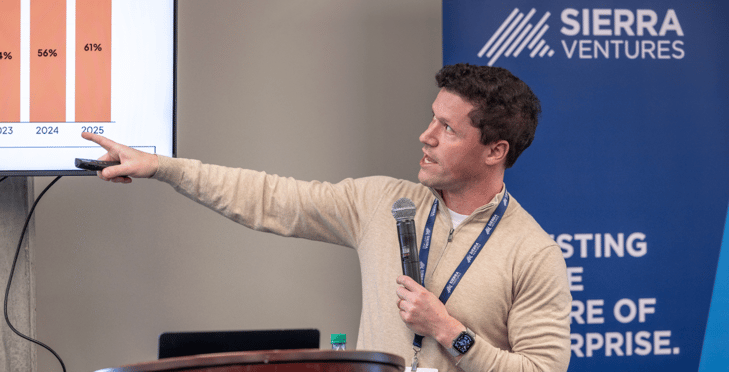
Peter Walker, Head of Insights at Carta, presented at Sierra Ventures' Pre-Seed VC Summit. Here's what the data from nearly 500,000 signed SAFEs and notes since 2018 shows (see the full presentation at the bottom of the post).
Venture's headline story is well-known: more capital, higher valuations, fewer deals. But the details in the data are more useful than the headline.
The top of the market is pulling away from everything else
The gap between median seed valuations and top-5% seed valuations was roughly 2.9x in 2019. It's now 4x and rising fast, with 95th percentile post-money seed valuations hitting $80M against a $20M median. More capital and attention are concentrating at the top, and it's accelerating.
San Francisco is a different market entirely
The location data is more extreme than most people realize. Bay Area seed valuations at the 95th percentile hit $162M in 2025. The same percentile for every other US city combined is $64M. The median in the Bay Area is $26M, versus $18M elsewhere. If you're not based there, you're not just playing a different game on valuation — you're playing a different sport. Peter's take: find great companies outside SF, fund them, then bring them in. Don't assume you have to be there to find them.
AI has compressed the timeline to scale in ways that change everything downstream
Anthropic hit $1 billion in revenue in two years. Cursor got there in three. Stripe took seven, Salesforce took ten. That compression changes what "good" looks like for every fund investing alongside or behind these companies. Good is now okay. Great is now good. The bar has moved, and it's moved fast.
Solo founders are everywhere. Investors haven't caught up.
36% of new startups in 2025 are solo-founded, the highest share ever recorded. Among VC-backed companies, that number drops to 20%. Some of that gap is intentional. A lot of it probably isn't.
Equal splits are the default. Vesting schedules often aren't.
Equal founder splits are increasingly common and easy to understand why — 44.6% of two-founder teams split equity equally in 2025, up from 34.5% in 2016. What's riskier is the number of companies that still lack vesting schedules. Over 25% of two-founder teams lose a co-founder by year four. Without vesting, that's often a company-ending event. The data support moving toward five or six-year vesting schedules to better match how long this journey actually takes.
20% option pools are too big. Almost nobody uses them.
The median option pool at seed is 12%, not 20%. Most early-stage companies won't spend anywhere near 20% of equity on employees in their first decade, especially as team sizes continue to shrink. Seed stage team size has dropped 39% since 2021, from an average of 10.3 employees to 6.2. Series A is now 16.8, down from a peak of 25.9. New hires per month across the startup ecosystem have fallen from 74,000 in early 2022 to around 32,000 by mid-2025, while funding has risen. Those two metrics have historically moved together. They no longer do.
Accelerators are setting the market, whether you compete with them or not
YC and a16z Speedrun are collectively backing close to 1,000 companies a year. When you do the math on YC's structure, most of their companies are selling 8-9% for $500K once you account for the full deal terms. That benchmark sits at the bottom of the dilution curve and shapes how every other early-stage investor prices. Whether you're competing with them for a specific deal or not, they are effectively setting market expectations for a large share of the founder population.
Getting to Series A is harder than the numbers suggest
At 24 months post-seed, roughly 14-17% of companies have reached Series A, compared to around 30% during the boom years. The good news is that graduation rates appear to be ticking back up slightly, and the median time between seed and Series A fell in the second half of 2025 to about 1.9 years, after trending higher for several years. A reasonable expectation going forward is somewhere in the 28-35% range, meaning roughly one in three seed companies will graduate. There will be many stranded companies in between.
Seed rounds are consolidating around fewer, more decisive investors
The typical lead investor used to take about 50% of a seed round. The median is now 60%, and in roughly one in ten cases last year, a single investor took the entire round. Seed is sharpening. The middle position, a competitive check without a real edge, is harder to defend.
Strong multiples are still findable everywhere. Unicorns aren't.
If you're hunting specifically for billion-dollar outcomes, the data supports paying up. Top-quartile seed valuations produce unicorns at 5.6%, versus 0.8% in the bottom quartile, for companies funded in 2016-2020. But if a 25x return is the goal, the distribution is nearly flat — 10.6% at the lowest valuation tier versus 8.8% at the highest. Strong multiples show up everywhere across the stack.
The real constraint is liquidity. IPOs are effectively closed below $5-8B. Acquisitions in the $1-3B range are thin. 2025 was a strong year for exits by volume, but the vast majority were small, early-stage companies. That's the part of the math that still needs to be solved.
Watch the video:
Written By