At Sierra Ventures, conversations with engineering leaders help us understand how AI is reshaping software development inside companies building at massive scale.
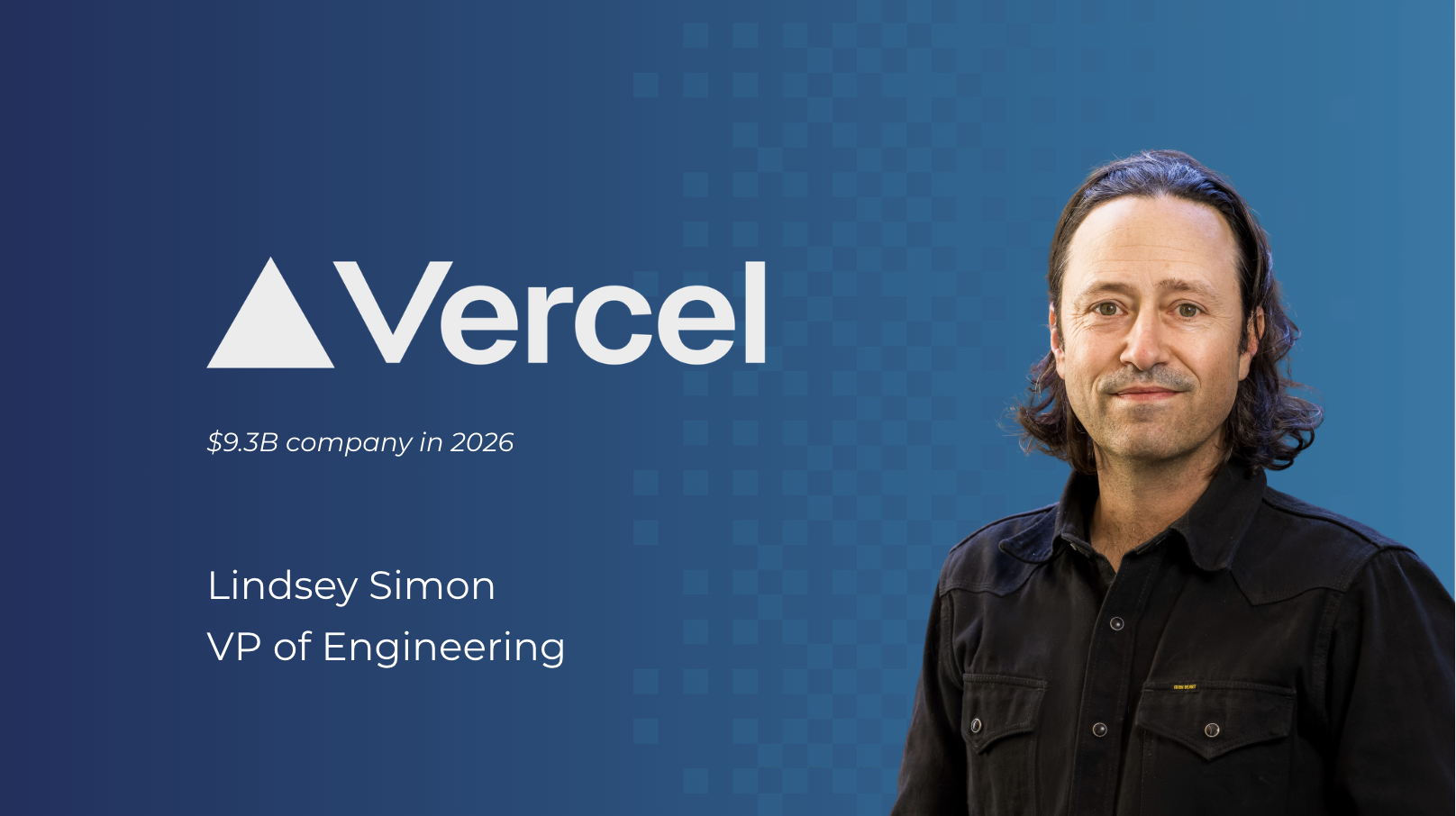
Anne Gherini recently sat down with Lindsey Simon to discuss what changes when code becomes abundant, why management now requires staying technical, and what separates great engineers from average ones in an AI-native world.
Lindsey has had a front-row seat to multiple platform shifts. He was early at Google App Engine in 2007, worked closely with Brett Taylor at Quip, and joined Vercel in 2020 when the company was still around 15 engineers. Today, Vercel has scaled into one of the most important developer platforms in AI-era software.
His core message was simple: AI changes the mechanics of software engineering, but not the importance of ownership, judgment, and effective thinking.
AI Makes Code Cheap. Judgment Becomes Expensive
One of the biggest shifts happening inside engineering teams is that code itself is no longer scarce.
AI systems can now generate working software at a speed that would have felt impossible only a few years ago. The result is a flood of new code entering production environments.
That changes the role of the engineer.
The highest-value engineers are increasingly the people who can define intent clearly, structure problems correctly, and recognize whether a system is solving the right problem in the right way.
Implementation matters less than understanding outcomes.
As AI accelerates code generation, the real bottleneck becomes evaluation: identifying poor design decisions, defining success criteria, and understanding tradeoffs before systems become difficult to maintain.
Why Test-Driven Development Matters More in the AI Era
AI coding workflows are also changing how teams think about testing.
For years, many engineering organizations treated tests as something written after implementation. But agentic workflows reward teams that define success and failure conditions upfront.
The clearer the desired outcome is, the more effective coding agents become.
This is increasing the value of test-driven development and automated validation loops across modern engineering organizations.
The best AI-native environments are increasingly designed around rapid feedback systems: fast compile times, automated checks, continuous validation, and infrastructure that keeps developers and agents operating in flow instead of waiting on tooling friction.
What Makes a Codebase “Vibe Codable”
The phrase “vibe coding” has become internet shorthand for AI-assisted development, but the underlying idea is more important than the meme.
The best engineering environments now optimize for momentum.
Long build times, heavy infrastructure dependencies, slow type checks, and complicated deployment workflows break flow for both humans and AI systems.
AI-native codebases increasingly require guardrails that allow agents to validate themselves continuously while still moving quickly.
In practice, the most effective engineering organizations are not simply adopting AI tools. They are redesigning workflows, repositories, and developer infrastructure around speed, iteration, and verification.
The Best Engineering Managers Still Need to Build
One of the strongest themes from the conversation was how leadership itself is changing.
Engineering managers can no longer operate purely as coordinators or process owners while staying disconnected from the tooling transformation happening underneath them.
As programming workflows evolve, technical credibility increasingly requires direct participation.
Leaders now need firsthand experience with AI-native development workflows to understand how engineering work is changing in practice.
That shift is pushing many experienced leaders back into hands-on building, experimenting, and coding again, not because they need to ship the most code, but because leadership requires understanding the reality of the work.
The managers gaining the most trust internally are often the ones willing to stay close to the tools and workflows changing their teams.
Why Great Engineers Think Before They Code
Despite the pace of change, one thing has not changed: the value of structured thinking.
The engineers who stand out are still the ones who break problems down clearly, ask strong questions early, and reason through systems before implementation starts.
AI amplifies good thinking. It also amplifies weak thinking.
Engineers who cannot define success criteria clearly or communicate tradeoffs effectively often create larger downstream problems faster.
Meanwhile, engineers who combine technical intuition with strong reasoning become dramatically more effective when paired with AI systems.
The skill is no longer memorizing syntax. It is understanding systems deeply enough to direct them effectively.
Why AI Is Raising the Bar for Engineers
AI is not reducing the need for strong engineers. In many ways, it is increasing the expectations.
The most valuable people are no longer just strong individual contributors writing clean code manually. They are people who demonstrate ownership, judgment, business understanding, and the ability to operate through ambiguity.
Hiring processes are evolving accordingly.
Many engineering organizations now expect candidates to use AI during technical interviews because AI-assisted development is becoming the default workflow in production environments.
The important signal is no longer whether someone can code without assistance. It is whether they can think effectively with modern tools, make strong decisions, and understand the impact of what they build.
Why Mission-Driven Builders Still Stand Out
One of the more interesting observations from the conversation was how little the core signals of great builders have changed.
The strongest engineers and founders still tend to share the same characteristics: deep curiosity, strong ownership, long-term commitment, and a desire to solve real problems for real users.
The best candidates are often the people already emotionally invested in the product, workflow, or market before they ever interview.
That pattern also shows up repeatedly in breakout developer companies. Users adopt products early not because the tooling is already perfect, but because the direction feels inevitable.
AI Will Make More People Creative
The most optimistic part of the conversation centered on creativity.
AI is dramatically lowering the barrier between having an idea and turning that idea into something tangible.
Work that previously required agencies, designers, developers, or technical specialists can increasingly be prototyped directly by individuals themselves.
That shift has the potential to expand who participates in software creation entirely.
The next generation of builders may not look like traditional software engineers at all. They may simply be people with strong ideas, good judgment, and the ability to direct increasingly capable systems.
At Sierra Ventures, conversations like this help us stay close to how engineering organizations are actually evolving as AI moves from experimentation into daily workflows inside modern software companies.
Watch the full conversation with Lindsey Simon below.
Watch the video:
.png?width=298&height=78&name=sierra-logo%20(1).png)
![SIERRA-Logo [Navy]](https://www.sierraventures.com/hubfs/SIERRA-Logo%20%5BNavy%5D.svg)