At Sierra Ventures, conversations with enterprise technology leaders are one way we stay close to how AI is actually deployed within large organizations, beyond the demos and headlines.
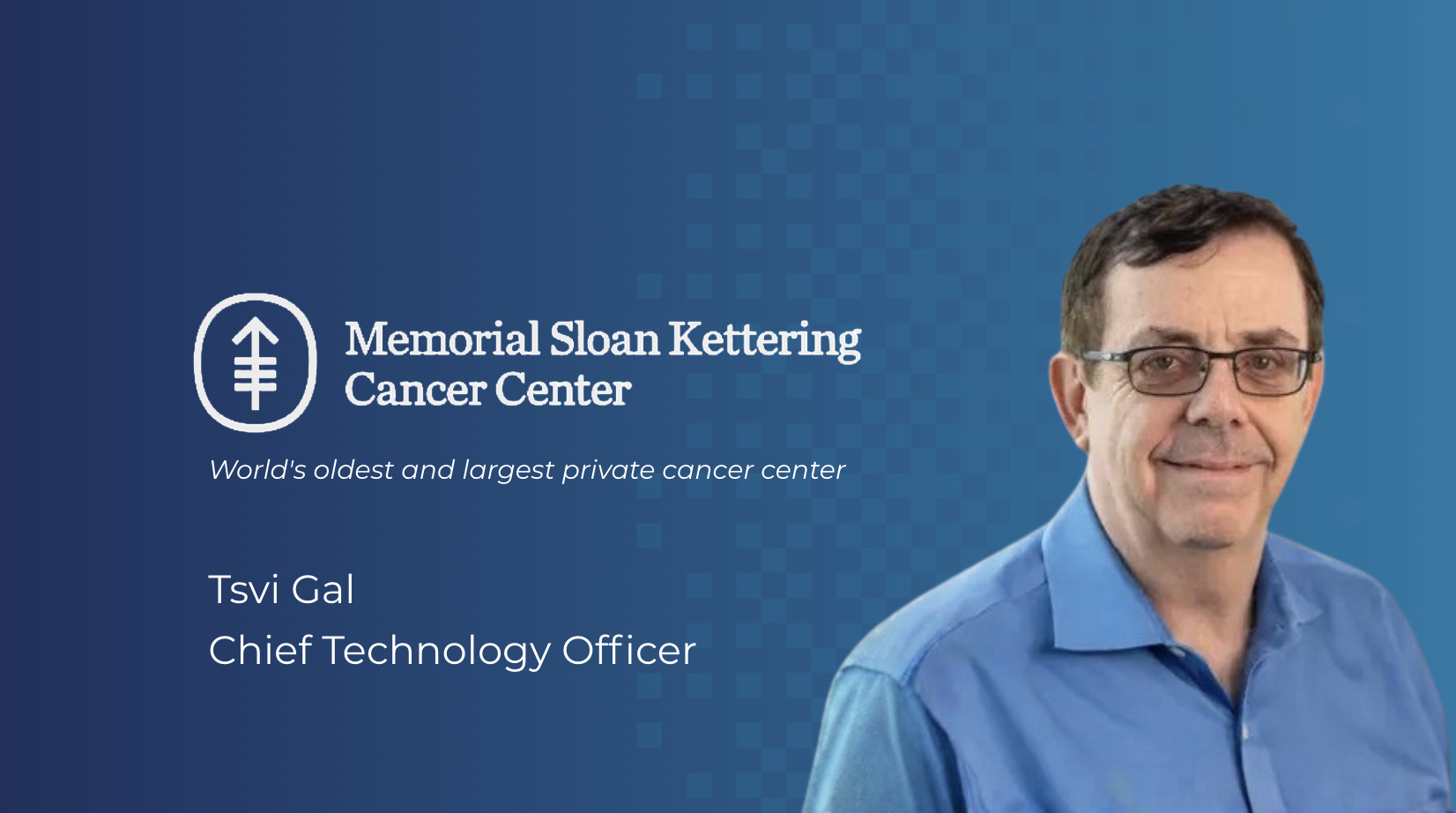
Mark Fernandes recently sat down with Tsvi Gal, CTO of Memorial Sloan Kettering Cancer Center, to discuss what AI looks like once it moves beyond pilots and into clinical and research workflows at scale.
Across a large organization supporting more than 160 research labs and over a million patient visits each year, MSK’s experience offers a clear view of where AI is already delivering measurable results and where the constraints are still real.
From 42 Minutes to Under One Minute
Five years ago, MSK's patient support line averaged a 42-minute wait time and a 27.5% abandonment rate. After deploying conversational AI, wait times dropped to under one minute, abandonment fell to near zero, and support costs declined 35%.
Adoption was not immediate. At launch, 82% of callers still chose a human agent. MSK kept those callers in the queue while AI users were served immediately. Within two months, that figure dropped to 12%. Today it is in the single digits.
One design decision proved foundational to building trust: when the system cannot answer a question, it routes to a human rather than generating a response.
Ambient AI Is Changing Documentation Workflows
Clinical documentation remains one of the largest administrative burdens in healthcare. MSK now uses ambient AI to automatically capture physician-patient conversations, generate structured clinical summaries, produce billing documentation, and deliver plain-language visit notes for patients. The result is not fewer notes. It is significantly less time spent producing them.
AI Is Already Inside Most Research Labs
Roughly 70% of MSK's 160 research labs are using AI as a primary or supporting tool. Applications span anomaly detection in imaging, genomic sequencing analysis, and computational drug discovery modeling. One emerging direction involves digital twins of mouse models that allow researchers to simulate genomic behavior before live testing, cutting years off the path from hypothesis to clinical validation.
Radiologists Are Getting Leverage, Not Replaced
Gal's position is direct: AI increases throughput; clinicians retain judgment. Radiologists review more images per day as AI surfaces anomalies earlier in the workflow. Final decisions remain with the physician. Progress is real, but so are the limits, and the reality sits well between the extremes of AI hype and AI skepticism.
Three Constraints Slowed Adoption More Than Expected
Healthcare organizations are not short on interest in AI. They face specific operating constraints.
Reliability. Hallucinations remain an unresolved limitation. Clinical environments require a level of accuracy that current systems do not consistently meet.
Data complexity. Healthcare data is fragmented, longitudinal, and context-dependent in ways that controlled demos rarely reflect.
Organizational structure. Hospitals were not designed for agent-based workflows. Integrating AI systems as operational contributors, with defined roles and clear limitations, requires new processes and a genuine shift in how teams are structured.
That transition is still underway across the industry.
What Healthcare Startups Should Understand Before Selling Into Hospitals
Gal identified several patterns that consistently separate credible vendors from the rest.
Listen before pitching. Enterprise buyers are rarely looking for someone to diagnose their problems. Demonstrating that you understand their environment first is a prerequisite, not a differentiator.
Depth over breadth. Domain-specific models frequently outperform general-purpose systems in clinical settings. Focused capability builds trust faster than broad claims.
Advice for New Graduates Entering the AI Era
Measure what matters to the buyer. In healthcare, ROI includes drug development timelines, patient outcomes, and quality-of-life improvements, not just cost reduction. Startups that speak tSome organizations are pulling back on entry-level hiring as automation improves. Gal views that as shortsighted. His advice to new graduates: become a fluent user of the tools, but do not mistake tool usage for thinking. Design, judgment, and genuine innovation still originate with people. Institutions that continue investing in early-career talent will be better positioned to adapt and to lead.
Watch the video:
.png?width=298&height=78&name=sierra-logo%20(1).png)
![SIERRA-Logo [Navy]](https://www.sierraventures.com/hubfs/SIERRA-Logo%20%5BNavy%5D.svg)




%20(1).jpeg)